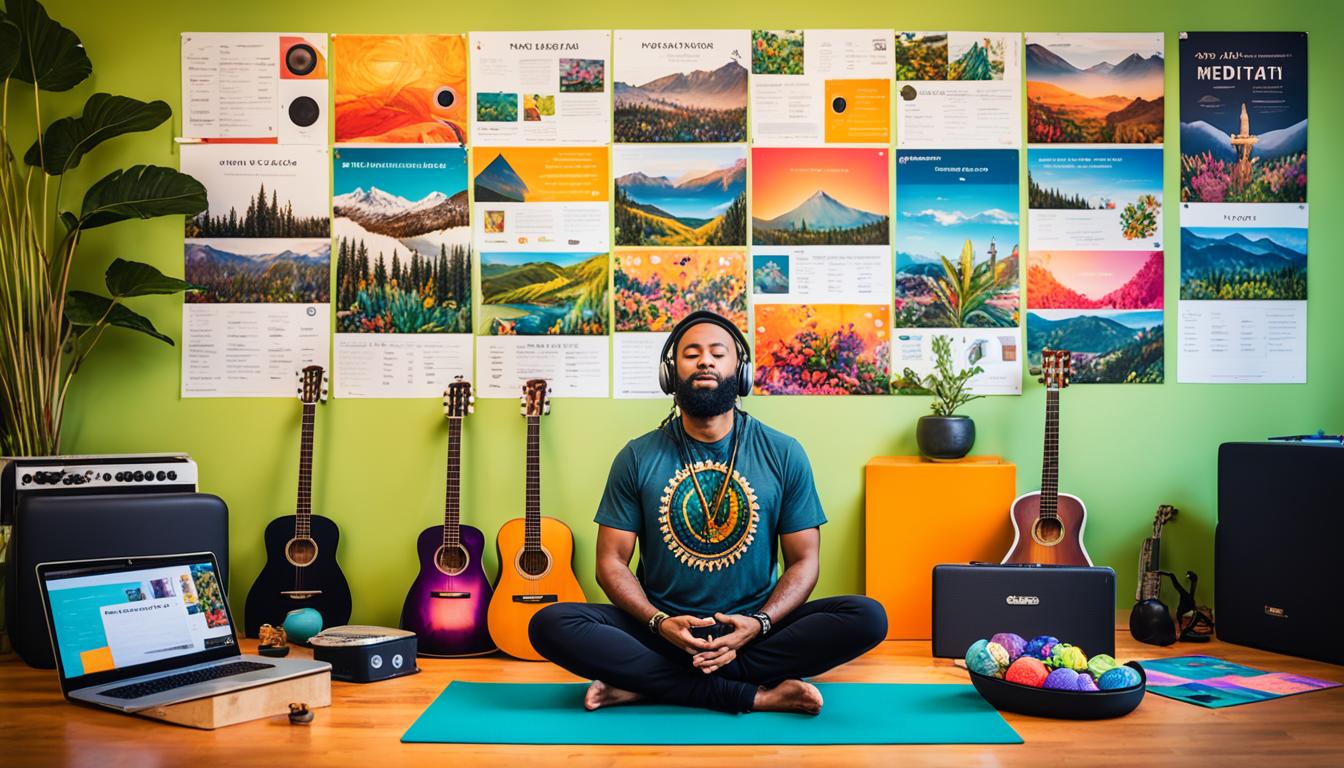
Meditation Playlist Creation can transform your mindfulness practice from ordinary to deeply transformative. The right combination of sounds, rhythms, and melodies creates a sonic sanctuary that supports deeper states of relaxation and awareness.
Whether you’re just starting your meditation journey or looking to enhance your existing practice, building the perfect playlist requires understanding how different musical elements affect your mental state. The key lies in selecting tracks that align with your meditation goals while creating a smooth, uninterrupted flow that carries you through your entire session.
TL;DR
- Keep tracks between 5-10 minutes long to match typical meditation session lengths without jarring transitions.
- Layer 3-4 different sound types – ambient tones, nature sounds, gentle instruments, and soft rhythms – for rich texture.
- Start playlists at 60-70 BPM and gradually slow to 40-50 BPM to naturally guide your nervous system into relaxation.
- Test volume levels between 30-40% of normal listening volume to create background support without distraction.
Meditation Playlist Creation: Building Your Sound Foundation
Creating an effective meditation playlist starts with understanding your personal meditation style and goals. Some practitioners prefer complete silence, while others find that carefully chosen sounds actually deepen their focus and relaxation.
The foundation of any great meditation playlist rests on three core elements: consistency, flow, and intentionality. Your tracks should maintain a steady energy level throughout, transition smoothly from one to the next, and serve a specific purpose in supporting your meditation practice.
Essential Components for Your Playlist
- Opening tracks – gentle, welcoming sounds that ease you into the practice
- Core meditation music – steady, minimal compositions that sustain focus
- Transition pieces – subtle shifts between different meditation phases
- Closing sounds – gradual return to awareness and alertness
Choosing Your Musical Style and Approach
The style of music you select directly impacts your meditation experience. Soundscapes for serenity can include everything from classical compositions to modern ambient electronic music.
Classical music works particularly well for concentration-based meditation practices. The mathematical precision of Bach or the flowing melodies of Debussy provide structure without demanding attention.
Popular Meditation Music Categories
- Ambient electronic – spacious, atmospheric sounds perfect for open awareness
- Nature recordings – rain, ocean waves, forest sounds for grounding
- Traditional instruments – flutes, harps, singing bowls for cultural resonance
- Drone music – sustained tones that support deep states
- Minimalist compositions – simple, repetitive patterns that don’t distract
Creating Balance Through Sound Layering
A balanced meditation playlist combines different sonic textures to create depth without complexity. Think of your playlist as having foreground, middle ground, and background elements working together harmoniously.
Start with a foundational drone or ambient pad as your background layer. Add gentle melodic elements in the middle ground – perhaps soft piano or flute. Use nature sounds meditation as accent elements that appear and fade naturally throughout your session.
Timing and Track Length Considerations
- Match your session length. Create playlists that run 5-10 minutes longer than your intended meditation time.
- Use seamless transitions. Choose tracks that fade in and out smoothly or edit them to remove abrupt starts and stops.
- Plan for different phases. Include settling music, deep practice music, and gentle return-to-awareness tracks.
Volume and EQ Settings
Set your meditation music 20-30 decibels below normal listening levels. Use EQ to reduce harsh frequencies above 8kHz and below 60Hz for a softer, more soothing sound profile.
Working with Binaural Beats and Frequency-Based Music
Binaural beats and meditation offer a scientific approach to meditation music creation. These specially designed audio tracks use slightly different frequencies in each ear to encourage specific brainwave states.
Alpha waves (8-13 Hz) support relaxed awareness, while theta waves (4-8 Hz) can facilitate deeper meditative states. However, binaural beats require headphones to work properly and may not suit everyone’s practice style.
Frequency Considerations
- 528 Hz – often called the “love frequency,” promotes healing and transformation
- 432 Hz – considered more harmonious than standard 440 Hz tuning
- 396 Hz – associated with releasing fear and guilt
- 741 Hz – supports self-expression and problem-solving
Incorporating Traditional and Sacred Sounds
Traditional meditation music from various spiritual traditions can add depth and cultural richness to your practice. The healing power of Tibetan singing bowls demonstrates how ancient instruments continue to support modern meditation practices.
Sacred sounds like Om chanting, Gregorian chants, or Buddhist mantras carry centuries of meditative energy. These sounds work particularly well if they resonate with your spiritual background or interests.
Traditional Instruments to Consider
- Tibetan singing bowls – crystal clear tones that promote deep relaxation
- Native flutes – earthy, grounding sounds perfect for nature-based meditation
- Harmonium – sustaining tones ideal for breath-focused practices
- Rain sticks – gentle rhythmic sounds that mimic natural rainfall
Testing and Refining Your Playlist
The best meditation playlist is one that disappears into the background of your awareness while still providing gentle support for your practice. Test your created playlists during actual meditation sessions, not just casual listening.
Pay attention to moments when the music draws your attention away from your meditation. Note which tracks feel too active or emotionally engaging, and replace them with more neutral alternatives.
Common Playlist Mistakes to Avoid
- Volume inconsistencies. Ensure all tracks play at similar volume levels to avoid sudden changes.
- Recognizable songs. Familiar melodies can trigger memories and thoughts that distract from meditation.
- Complex rhythms. Intricate percussion or syncopated beats can overstimulate the mind.
- Sudden endings. Tracks that stop abruptly can jar you out of meditative states.
Creating Playlists for Different Meditation Types
Different meditation practices benefit from different musical approaches. Mindfulness vs concentration meditation requires distinct sonic environments to support each practice style effectively.
Mindfulness meditation often works best with open, spacious soundscapes that don’t impose structure on your attention. Concentration practices may benefit from more rhythmic or repetitive elements that support sustained focus.
Style-Specific Recommendations
| Meditation Type | Best Music Style | Key Features |
|---|---|---|
| Mindfulness | Ambient, nature sounds | Open, spacious, non-directive |
| Concentration | Repetitive patterns, drones | Steady rhythm, minimal variation |
| Loving-kindness | Warm, melodic instruments | Heart-opening, gentle melodies |
| Body scan | Slow, flowing compositions | Gradual movement, soothing tones |
Articles You May Like
Frequently Asked Questions
How long should my meditation playlist be?
Create playlists 5-10 minutes longer than your typical meditation session to avoid ending abruptly. For a 20-minute practice, aim for 25-30 minutes of music.
Should meditation music have vocals or lyrics?
Generally avoid lyrics in languages you understand, as they can engage your thinking mind. Simple mantras or vocals in unfamiliar languages may work if they feel supportive rather than distracting.
Can I use the same playlist for different types of meditation?
While possible, different meditation styles benefit from different musical approaches. Create separate playlists for concentration, mindfulness, and movement-based practices for best results.
Is it better to use headphones or speakers for meditation music?
Both work well – choose based on comfort and setting. Headphones provide more immersive experience and are required for binaural beats, while speakers create a more natural sound field.
Final Thoughts
Meditation Playlist Creation is a personal art form that deepens with practice and experimentation. The perfect playlist supports your meditation without becoming the focus, creating a sonic container that holds space for inner exploration and peace.
Start with one style that appeals to you and gradually expand your collection as your practice develops. Remember that the best meditation music is the one that helps you access deeper states of awareness and calm.
—
##